
A Quiet Breakthrough in Humanoid Learning
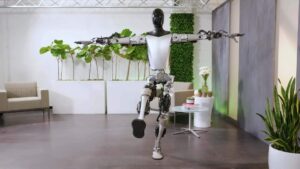
Tesla’s Optimus robot made global headlines this year not just for its choreography, but for how it’s learning. In a May 2025 video, Optimus was shown doing everyday work like vacuuming, taking out the trash, stirring a pot, and even closing curtains all taught by watching humans, not by being tele-operated. This is less showmanship, more a fundamental shift in robot training.

Learning by Observation, Just Like Humans
Elon Musk and Tesla’s robotics team say Optimus now learns from first-person videos of humans doing tasks. According to Milan Kovac, Optimus’s engineering lead, many of these skills can be triggered via natural language voice or text all handled by one multitasking neural network running on the bot.

From Motion Capture to Video Data
This marks a sharp departure from the old-school way of teaching robots: motion-capture suits or teleoperation. Instead, Tesla is using video data cheap, abundant, and diverse. Musk believes such “task-extensibility” could let Optimus learn almost anything, if it’s shown enough relevant human videos.
The Risks Behind the Vision-Only Approach
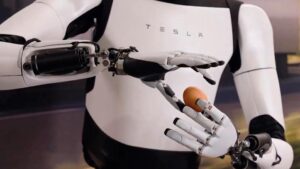
Holding a camera doesn’t tell you how stiff something is or how much pressure to apply while stirring vision alone misses force, texture, haptics. Observers warn that without force sensing or reinforcement-learning, robots might perform brittle or unsafe actions. Some argue for hybrid models that combine visual imitation with touch-based testing.

Research Paves the Way
It’s not just Tesla. Recent research supports this video-based training push. For instance, a new paper called H2R proposes transforming human videos into “robot versions” by replacing human hands with simulated robot arms, reducing the visual gap between humans and machines. Another study, ViSA-Flow, learns a “semantic action flow” from large-scale human-object interaction videos then adapts that knowledge to real robots.

Real-World Signals Are Emerging
On the industry side, we’re seeing proof-of-concept deployments. General-purpose robot firms are experimenting with multi-robot models trained on video and simulation data. Amazon-backed Skild AI recently launched “Skild Brain,” a shared learning model that draws on simulation, human-action videos, and live feedback from deployed robots.

Why This Matters
For industrial backbone, factories, warehouses, and small manufacturers this could be a game-changer. Robots that learn from cheap video can adapt quickly to local tasks without massive reprogramming. That means faster automation, lower training cost, and possibly a jump in productivity. But with that comes a social responsibility: reskilling workers, creating safety norms, and ensuring robots don’t worsen inequality.

Turning Points: Trust, Safety, and Scale
The real story now lies in scaling safely. The questions are technical how to fuse vision-based learning with force and planning and social: will managers trust robots to learn on the job? Will regulations keep up? The companies that figure out both will likely dominate the next wave of humanoids.
A New Economic Framework for Robots
Tesla’s shift reframes the economics of robot learning. Video-based training slashes cost, speeds up learning, and lets robots generalize across tasks. If Optimus and its peers succeed, we could be looking at a future where humanoids aren’t expensive lab curiosities, but scalable industrial assets.

Why 2025 Might Be a Turning Year
The viral Kung Fu video of Optimus wasn’t just to show it was proof. This year’s real innovation lies in how robots are being taught, not just what they can do. If vision-led learning scales, 2025 could mark the year when humanoid robots move from demonstrations into real-world work. And in that shift lies a quiet revolution.