

Thesis project into world’s first commercial microplastic removal company
Catching Plastic Before It Reaches the Sea
In September 2024, Yidian Liu stood at a wastewater plant in New Jersey, watching millions of gallons of treated water head toward the Atlantic. What was invisible was the impact; her company had already removed 520 million microplastic particles from that flow in a year. That is around 1.5 kilos of plastic, roughly equal to 30,000 grocery bags shredded into tiny pieces, stopped before reaching the ocean.
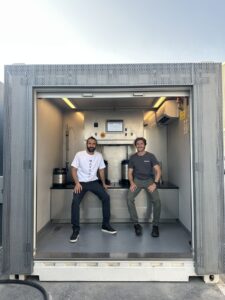
Liu and her co-founder, Nathaniel Banks, never planned to start a company. In 2021, as architecture students at Princeton, they were researching plastic waste for their thesis. They were shocked to find that while systems existed for large plastic waste, almost nothing addressed microplastics smaller than a millimetre. Existing solutions were either too expensive or impractical.
That gap led to PolyGone Systems. Founded in 2021, the startup now runs the world’s first municipal-scale pilot to remove microplastics from wastewater. With California set to expand microplastics testing in drinking water by 2026, a step that could trigger new wastewater rules, PolyGone is arriving just as regulation and urgency finally catch up.
From Pretty Designs to Plastic Killers
Both founders came from elite design studios. Banks trained at Zaha Hadid Architects and David Chipperfield, while Liu worked at Vector Architects and LOLA Landscape. They had awards, strong portfolios, and a sharp eye for beauty. But they knew good design alone would not solve the microplastics crisis fast enough.
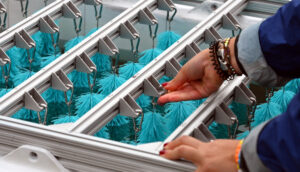
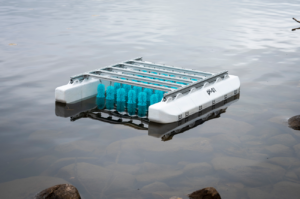
Within two years, they launched their first industrial pilot. By early 2025, they were shipping commercial systems. The idea came from nature. Aquatic plant roots trap microplastics through fibrous, gel-like structures. Recreating this in the lab, the team built coconut-fibre filters that mimic root cavities. The result was the Artificial Root Filter, capturing up to 98 per cent of microplastics, even the invisible ones.
What made it work was practicality. The systems run passively, clean themselves, fit inside shipping containers, install in a day, and cost $15,000 to $50,000, far cheaper than traditional filters.
That focus won customers. After a pilot in Atlantic County, a California wastewater utility signed on in April 2024. Soon after, PolyGone expanded to Dubai, filtering pollution directly at industrial sources.
How PolyGone Made Pollution Pay
PolyGone shows how climate hardware startups survive long, expensive build cycles. Before raising a $4 million seed round, founder Liu secured $2.4 million in non-dilutive grants from Princeton, the NSF, NOAA Sea Grant, and New Jersey agencies. That money proved the tech without giving up equity.
By the time Unshackled Ventures and Fyrfly led the round, PolyGone already had working systems and paying customers. The New Jersey Innovation Evergreen Fund joined in December 2024, and the raise closed in just six months, rare for climate tech.
PolyGone sells physical infrastructure, not software. Cities and factories either buy the system or pay for long-term service. For cities, it means avoiding future regulation. For manufacturers, it means staying ahead of sustainability pressure.
Textile factories are the entry point. Synthetic clothes shed massive microfibers, and regulations are coming. PolyGone stops pollution at the factory itself, turning compliance into a brand advantage. Its Dubai pilot proves this model.
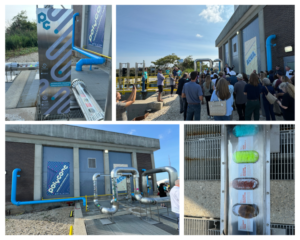
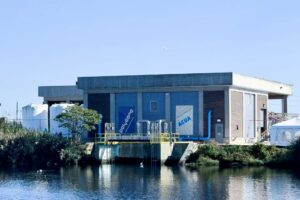
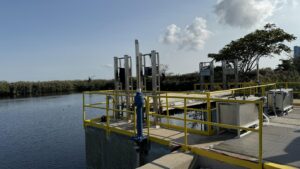
The tech already works at scale. In Atlantic City, PolyGone treats 40 million gallons of water daily, removes 91 percent of particles, and reuses its filters. Most city projects pay back in three to five years. Future reuse of captured microplastics is still early, but the groundwork is done.

California Moves, the World Listens
In 2026, California will test microplastics in treated drinking water. If levels are high, tough rules will follow, covering wastewater, stormwater, and industrial discharge. That move will likely push other U.S. states to act. New York City is already lining up.
PolyGone is getting ahead of it. Its pilot shows microplastics are a real problem, and that they can be filtered at scale. By proving compliance is possible, the company is quietly shaping future rules.
Globally, change could come even faster. Europe tends to regulate early, and pilots in places like Dubai show global demand. PolyGone stands out because its system is simple, low-energy, and affordable. No high-pressure pumps. No complex tech. Just smart engineering.
The team is small, just ten people, all working hands-on in New Jersey. No hype. No software. Just real science, built and tested under one roof.
Catching Plastic Before It Reaches the Ocean
PolyGone is moving fast. It plans to launch commercially, starting with the Poly Pod. The timing is sharp. By mid-2026, California will release drinking water test results, putting pressure on utilities, manufacturers, and fashion brands to prove real microplastic reduction, not just ESG talk.
The company is preparing for that moment. Its Atlantic City pilot is scaling up. Projects in California and Dubai show the tech works across regions and industries. PolyGone is also expanding fabrication, a clear sign that it expects demand to grow.
Two challenges remain. Upcycling captured microplastics is still unproven at scale. If that fails, safe disposal is the fallback. Adoption is also slow. Cities move cautiously, industries want proof, and utilities are cost-driven.
Founder Banks stays grounded. Built in the field. Improve with data. Let results speak. No hype. The opportunity is massive. The US alone has over 16,000 wastewater plants. Globally, thousands release microplastics every day. Any place where plastic meets water is a target. PolyGone’s edge is simplicity. No moonshots. No big promises. Just practical systems, inspired by nature, ready to close a real infrastructure gap.
Fixing the Unseen Problem
At Davos this January, PolyGone won the Earth05 Co-Creation Prize. That mattered. A small, design-driven startup working on real infrastructure, not software hype, was recognised on a global stage.
It signals a shift. Microplastics are no longer just a research issue. Regulation is coming fast, and what’s needed now are solutions that work in the real world. PolyGone moved early by building and deploying systems, not waiting for perfect conditions. The lesson is simple. Start with pilots. Use grants to reduce risk. Build for real use, not theory. Treat regulation as momentum, not fear.
AI will dominate headlines in 2026. But the startups that truly matter may be the quiet ones solving hard, invisible problems. When enforcement begins, these are the companies utilities will call. Sometimes the most important innovations don’t feel revolutionary. They just work.
Plastic Is Now Inside Us. The Clock Is Ticking.
Between 2024 and 2025, science crossed a line we cannot ignore. Major studies found microplastics inside human arteries, brains, reproductive organs, breast milk and placentas. A landmark medical study showed they double the risk of heart attacks, strokes and death. Stanford researchers revealed we now ingest roughly a credit card’s worth of plastic every week. New research links microplastics to cancer, Alzheimer’s, fertility issues and heart disease.
In fall 2026, California begins testing microplastics in treated drinking water, the water that actually flows from taps. If contamination shows up, statewide limits on wastewater discharge are likely. California usually sets the tone for the rest of the US.
When that moment arrives, PolyGone is the only company with a proven system ready to meet it.