

A Vision That Started Like Sci-Fi
When Lila Sciences began two years ago under Flagship Pioneering, it felt like a story from a futuristic novel. Geoffrey von Maltzahn, a scientist with a habit of chasing unusual ideas, wanted to build something bold, almost unbelievable, an AI system that could actually design, run, and learn from real experiments. Not just read research papers or summarise data, but behave like a super-smart scientific partner.
For Geoffrey, this idea came from years of watching how slow and repetitive lab work can be. His own journey as a scientist taught him how much time gets lost in manual experiments, human errors, and waiting for results. He imagined a world where machines could think faster than humans and where discoveries did not get stuck behind bottlenecks.
This dream shaped Lila’s early team too. A mix of engineers, roboticists, and molecular biologists came together, driven by a shared belief that science could be faster and more creative. There were late nights, long debates, and many failed prototypes. But every failure led to learning, and every learning made the AI smarter.
By late 2025, that “sci-fi idea’’ had turned into a company valued at more than 1.3 billion dollars, backed by Nvidia. For Geoffrey and his team, this was personal validation. Their belief in a new way of doing science was no longer a thought experiment. Investors and industry partners were now paying attention.

How Lila Built a New Model for Discovery
The Science That Learns By Doing
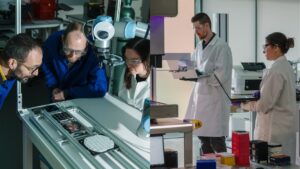
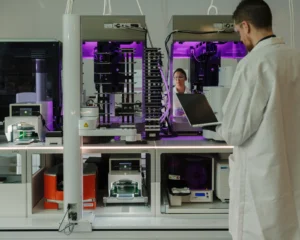
Most AI models are trained on internet text. Lila went the opposite way. They trained models on real experiments. The company built automated labs with robotic benches, continuous assays, and closed-loop systems that allow the AI to run experiments, learn from results, and improve its predictions.
This vertical approach took longer in the beginning, but it created something powerful. The AI does not guess. It learns directly from physical reality.
For entrepreneurs, the lesson is clear. Vertical depth takes time, but it builds a stronger moat. Lila focused on control, accuracy, and trust over speed, and it paid off.
Trust Between Silicon and Glass
One of Lila’s biggest challenges was building trust between machines and human scientists. The team had to create rules for how the AI proposes experiments, how it measures uncertainty, and how it logs every failure as training data.
This is an important insight for any founder, especially those working with AI. Trust is not built by showing results. It is built by showing how those results were created.
Lila turned physical experiments into first-class data input. This gave the platform a major advantage. Once they built this foundation, discoveries started happening faster than traditional labs could manage.
Nvidia’s Backing and the Scale Moment
Nvidia joining the October 2025 round was a turning point. The money was important, but the deeper access to chips and tools mattered more. Lila’s entire model depends on running thousands of simulations and experiments in tight loops. Faster compute means faster learning. Faster learning means stronger results.
With a Series A that now totals about 350 million dollars, and overall capital of 550 million dollars, Lila is not a prototype company anymore. It is an industrial operator. Their new 235,500 square foot space in Cambridge is built to support high-throughput science and major enterprise partnerships.
The message to entrepreneurs is simple, scale is not just about funding. It is about having the right tools at the right time.

Two Inflection Points That Changed Lila’s Path
1. Quiet Validation Inside the Lab
The first major moment happened internally. Lila’s AI started producing candidate molecules that outperformed human-designed ones. It was not a press release moment. It was a quiet confirmation that their approach works. For investors, this was the moment hype turned into confidence.
2. A Smart Business Pivot
Lila could have stayed a pure research lab. Instead, they widened their model. Enterprise clients did not want exclusive rights to spin-out IP. They wanted access to the software. So Lila evolved into a hybrid SaaS plus lab platform.
This gave them multiple revenue streams, made partnerships easier, and reduced risk.
For entrepreneurs, this is a key insight: Great science builds credibility, but great business models build longevity.

What Lila Means for the Future of Science
If Lila succeeds at scale, the impact will be structural. Discovery cycles in materials, energy, semiconductors, and pharma could shrink. AI-guided experiments may become the new normal, and competitive advantage will shift to companies that combine computation with automation.
But there are questions.
Who owns the data generated by these AI-driven experiments?
How do you manage risk when algorithms run physical tests?
Lila says it is building strong governance, but both regulators and enterprise partners will watch this closely.

Why Investors Are Betting on “AI for Science”
Venture capital is now moving beyond chatbots. Investors are chasing AI systems that can act, not just analyse. Lila sits right at the centre of this shift.
For incumbents, Lila offers speed and precision.
For founders, it offers a blueprint for building deep-tech companies with real impact.
For investors, it represents the possibility of multiplying human creativity with machines that learn faster than any lab team.
Whether Lila becomes the industry-defining company or one of several leaders will depend on execution, trust, and how quickly the world accepts automated experimentation as real science.