
When Guillermo Rauch started building a small JavaScript project in 2015, he was not trying to create a venture-backed company. He was trying to fix a problem he faced every day as a developer. Building fast websites was hard. Deploying them was harder. The tools were messy, slow and frustrating.
That open-source project became Next.js. And Next.js became the foundation for Vercel, one of the most influential developer startups today.

From a side project to a real company
A founder driven by frustration, not funding
Guillermo Rauch grew up in Argentina and started coding at a young age. He did not follow a traditional startup path. He dropped out of college, worked as a freelancer and spent years contributing to open-source software. His motivation was simple. Make the web easier to build.
At the time, frontend developers were expected to handle complex backend setups just to launch a fast website. Rauch believed this was wrong. He started Next.js as a side project to solve a narrow problem: server-side rendering for modern web apps, without complicated configuration.
Developers loved it. Word spread organically. Big companies like Netflix and Uber began using Next.js, even though there was no company behind it yet.
The moment the idea became a business
As adoption grew, Rauch saw a pattern. Teams loved Next.js, but struggled to deploy and scale it smoothly. That gap became the opportunity.
In 2016, he co-founded a company called ZEIT, later renamed Vercel. The idea was clear. Keep Next.js open-source and free, but build a managed platform that makes deploying it effortless.
Money was tight early on. The team funded itself partly through consulting. But they built habits that shaped the company. Listen closely to developers. Ship fast. Improve constantly. Build in public.
The turning point came when developers began associating Next.js and Vercel as one experience. That is when the company truly took off.

How Vercel built a strong business around developers
A clear business model
Vercel follows a bottom-up model. Developers start using the platform for free. When products go live and start scaling, teams pay for usage, performance and collaboration features.
This approach avoids long enterprise sales cycles early and lets product quality drive growth. Revenue grows as customers grow.

Product focus over expansion
Vercel does not try to do everything. It focuses on one promise: the best platform for frontend development and deployment.
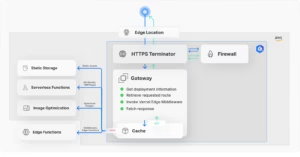
Instead of competing with cloud providers or design tools, it integrates with them. GitHub, cloud platforms, AI APIs and design software all plug into Vercel’s workflow. This focus keeps the product simple and strong.
Growth without heavy marketing
Vercel’s go-to-market strategy is led by developers, not sales teams. Engineers bring Vercel into their companies because it makes their work easier. Sales come later, when teams already depend on the platform.
This approach helped Vercel grow efficiently, especially as investor attention shifted from growth at any cost to real revenue and unit economics.

Learning from mistakes and pressure
Growth was not smooth. As usage increased, outages and performance issues hurt trust. Instead of rushing new features, the team paused and focused on reliability and infrastructure. It was a difficult decision, but it strengthened the platform.
Rising cloud costs and tighter funding forced discipline. Vercel responded by improving efficiency and pricing transparency.
Riding the AI wave without losing focus
As AI-powered apps became popular, Vercel adapted quickly. It introduced edge functions and AI-related tools to support faster, more responsive applications.
The company’s belief is simple. As AI products grow, frontend performance becomes more important, not less. Vercel wants to be the layer where AI meets real users.

Competition and long-term positioning
Vercel competes with companies like Netlify, Cloudflare and large cloud providers. Its edge is not price or scale. It is a developer experience.
The company hires engineers who care deeply about product quality and open source. Many are long-time contributors, not typical corporate hires.

Why Vercel matters going forward
Vercel’s story shows that strong businesses can be built quietly. No hype. No shortcuts. Just clear thinking and deep focus on users.
As software becomes more complex, the winners will be the companies that hide that complexity best. Vercel is building exactly that layer. Calm, invisible and hard to replace.