

A Vision Beyond the Eye
Founded in 2023 by serial entrepreneur Roman Axelrod and physicist Dr. Valentyn Volkov, Xpanceo has leapt into the global spotlight with its audacious goal: build a smart contact lens that not only augments reality but also monitors health and even provides night vision. In July 2025, it closed a $250 million Series A round, elevating its valuation to a unicorn-level $1.35 billion.

Founders at the Helm: Building on Physics and Entrepreneurship
Roman Axelrod, in his mid-thirties, is a veteran in start-up circles. Before Xpanceo, he founded and scaled several deep-tech companies. His co-founder, Dr. Valentyn Volkov, brings a rare pedigree: a physicist with deep experience in optics, materials science, and biomedical engineering. Their complementary strengths Axelrod’s deal-making and growth mindset, and Volkov’s technical rigor created the perfect storm for a genuinely disruptive hardware-AI startup.

A Market That Blurs Boundaries
Xpanceo is playing in multiple, enormous markets. On one side, there is the AR (augmented reality) wearables segment, expected to reach tens of billions in the coming years. On the other hand, medical diagnostics their lens could monitor tear fluid for biomarkers, opening doors into healthcare. Further, defence and security sectors may be interested in their planned night-vision capabilities. That convergence of consumer tech, healthcare, and defence gives Xpanceo a rare, cross-industry runway.

What Makes the Lens Unique
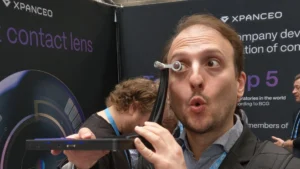
Unlike traditional AR glasses, Xpanceo’s lens sits directly on the eye. The design is low-profile, enabling real-world vision plus “smart” features. The team claims their prototypes can support wireless charging, intraocular pressure monitoring, and even optical zoom. This is not just smart eyewear it’s a potential unified digital interface, replacing screens with your own eye.
Business Model & Revenue Strategy
Xpanceo plans to begin with enterprise clients, especially in healthcare and medical research, where regulatory pathways are more clearly defined. Revenue will come from device sales (the lenses), subscription models for health-monitoring services, and licensing the technology to other players. Over time, the company hopes to scale down costs and democratise the product for consumer adoption. The model is capital-intensive, but the $250 million round gives them a strong foundation to deliver.

Early Traction & Momentum
By July 2025, Xpanceo has already built 15 working prototypes, ranging from models with tear-fluid sensing to ones with charging and zoom. Their R&D team, now about 100-strong, is pushing toward regulatory approval, especially aiming to kick off FDA-related processes by 2027. The scale of their Series A reflects real confidence from investors in their roadmap.

Scaling Up: From Niche to Mass
Once regulatory hurdles are cleared, Xpanceo’s vision is to expand globally not just in the Middle East or Europe, but to North America and Asia. Their manufacturing model, however, will be crucial: lenses require micro-fabrication, biocompatible materials, and high precision. If they crack cost-effective production, their scalability is enormous.

Competition: Giants and Startups Alike
Xpanceo is not alone. Big tech companies like Google and Samsung have toyed with smart eyewear or similar wearable interfaces. But few are tackling the contact-lens form factor. That said, rivals in AR, health-tech, and wearables will be watching closely. Xpanceo’s advantage lies in its scientific depth and early, working prototypes.

Possible Exit Paths
Given its valuation and ambition, potential exits could go in multiple directions. A strategic acquisition by a tech giant (like Apple or Samsung) is plausible. Alternatively, a spin-out IPO for the medical-monitoring arm or a licensing deal with healthcare firms could unlock value. Even partnerships with defence contractors are on the table.

Vision & Financial Discipline
Despite the deep-tech nature, the founders are prudent. The $250 million raise shows they are serious about long-term research and regulation. Yet they are not burning capital recklessly by focusing first on enterprise use cases, they are balancing risk and runway. Their vision isn’t just to build a gadget, but a new visual interface for the world.

Looking Ahead
Xpanceo’s journey is just beginning. If they succeed in delivering fully functional, safe, and affordable smart lenses, they could redefine how we interact with technology. Imagine a world where your eyes become the screen: where AR lives seamlessly in your blink, health data streams in real time, and digital and physical realms merge. For now, with their Series A fuel and visionary team, Xpanceo is one of the most exciting global startups of mid-2025. Its impact could ripple across consumer tech, healthcare, and even security transforming not just what we see, but how we live.


