

When Proxima Fusion launched in Munich in 2023, most observers viewed commercial fusion energy as a distant dream. Yet today, as the company closes in on a major engineering milestone, it finds itself at the heart of a global energy transformation. With the goal of delivering the world’s first commercial stellarator-based fusion plant, Proxima is redefining what a “startup” can look like in 2025 deep tech, capital-intensive and, if it succeeds, world-changing.
Science Meets Scale
The founding team brings heavyweight credentials. The company is a spin-out from the Max Planck Institute for Plasma Physics (IPP) and counts among its co-founders Dr Francesco Sciortino (CEO) and Lucio Milanese. The early hires include engineers and physicists drawn from institutions like MIT and major sectors including superconductors and aerospace.
This founding strength matters: fusion is one of the hardest engineering problems humanity has ever faced. By assembling a team that combines fundamental plasma science with industrial design and manufacturing know-how, Proxima appears to be stacking the odds in its favour.
A $1 Trillion Energy Platform
Global electricity demand is still rising and the push to decarbonise is urgent. Fusion promises virtually unlimited, zero-carbon power, which could transform energy-intensive industries, data centres, manufacturers and whole grids. Analysts estimate the prize at hundreds of billions of dollars annually once fusion is commercialised. According to one investor note, “If there’s one company that can be a trillion-dollar business globally, it might be Proxima.”
For Proxima, the opportunity is also geopolitical. Europe has long relied on external sources of fuel and sees fusion as a path to technological sovereignty and energy resilience.

Stellarators and Simulations
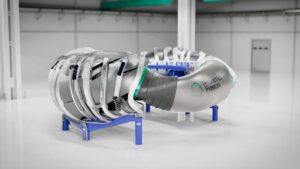
What sets Proxima apart is its engineering route. Rather than the more common tokamak design, the company pursues a quasi-isodynamic (QI) stellarator architecture with high-temperature superconducting (HTS) magnets.
Stellarators offer the promise of stable, continuous plasma confinement rather than pulsed operation. Proxima also emphasises a simulation-first approach, using advanced computing and AI tools to optimise magnet design and system integration.
In short: they’re not just trying to build a physics experiment, but an industrial-scale system from the ground up.

Licences, Plants, Global Roll-out
Proxima’s business model foresees multiple revenue streams: licensing its designs, building demonstration plants and then deploying modular units for utilities and heavy industries. With fusion power plants on the horizon for the 2030s, each gigawatt plant could generate revenues in the hundreds of millions annually. As deployment scales, recurring service, maintenance and upgrade contracts add long-term revenue potential.
The path is capital-intensive and long-term, but the payoff utility-scale clean power globally is enormous. Given the funding raised, investors appear to accept the long timeline.

Capital, Milestones, Credibility
In June 2025 Proxima raised €130 million (~US$150 million) in a Series A, the largest private fusion funding round in Europe. By September 2025 it extended the round to reach €200 million total funding.
They have published peer-reviewed designs for their “Stellaris” plant concept and are targeting manufacture of the first “Stellarator Model Coil” by 2027, with demo plant “Alpha” aiming for 2031.
That level of progress for a fusion-tech startup is noteworthy; it moves them beyond pure theory into execution.
From Prototype to Planet-Scale
The plan is systematic: build the coil, validate the design, then manufacture the plant, then roll out globally. The use of advanced manufacturing, HTS materials and digital simulations means once the core technology is de-risked and industrialised, scale-up becomes feasible.
Moreover, the modular nature of power plants means Proxima can serve global markets relieving grid constraints in Europe, Africa, Asia, Latin America. Given its early Europe-centric team and funding, the global role is still ahead, but the blueprint exists.

A Crowded Race
Yet this isn’t unchallenged territory. In fusion, established players include Commonwealth Fusion Systems and a host of other startups. The industry is moving from science labs into private equity territory. What makes Proxima unique is the stellarator route and European base. But question marks remain: Will time-to-net-energy gain be faster than competitors? Will cost per gigawatt scale competitively? Fusion remains high-risk, high-reward.
That said, Proxima’s narrative, European sovereignty plus industrial-grade design gives it a distinct identity.

Exit Possibilities: More Than Just M&A
Given the capital-intensity and time horizon, exit may not be a typical acquisition. Potential scenarios: (1) a public listing once the demonstration plant completes and revenue streams begin; (2) strategic partnership or partial acquisition by a major energy company seeking fusion capability; (3) spin-out of manufacturing units for HTS magnets or simulation software as separate businesses.
Given the scale, Proxima is shaping up less like a typical startup and more like a platform or infrastructure venture. That raises the possibility of multi-billion-dollar valuations if all goes according to plan.
Big Dream, Smart Execution
Proxima casts its vision broadly: deliver safe, clean, commercial fusion power in the 2030s, transforming energy systems and enabling net-zero everywhere. At the same time they emphasise milestones, hardware delivery and de-risking, rather than vague promises. The funding announcements and public disclosures suggest a discipline in engineering and investment choices that many deep-tech ventures lack.
In short: big ambition, but grounded in roadmap and metrics.

Looking Ahead: Powering the Future
By 2030, if Proxima hits its targets, we could be witnessing the first commercial fusion plant built on stellarator architecture, sending gigawatts of clean power into grids, cutting reliance on fossil fuels and reshaping industries. The ripple effects: lower carbon emissions, energy-price stability, improved energy security, and a new industry of fusion manufacturing.
If they succeed, the impact won’t just be technical—it will redefine how we power civilization. If they don’t, the experiment still advances the frontier and may spawn spin-offs of core technologies (superconductors, simulation platforms, manufacturing) with broad value.
Either way, the world will watch, and the stakes are planetary.
In short: Proxima Fusion is a rare breed—a startup with deep science, industrial ambition, global scale and a meaningful shot at reshaping the energy landscape. The next few years will tell whether fusion moves from promise to power—but for now, this company deserves a place at the table.