Chemistry meets bold ambition
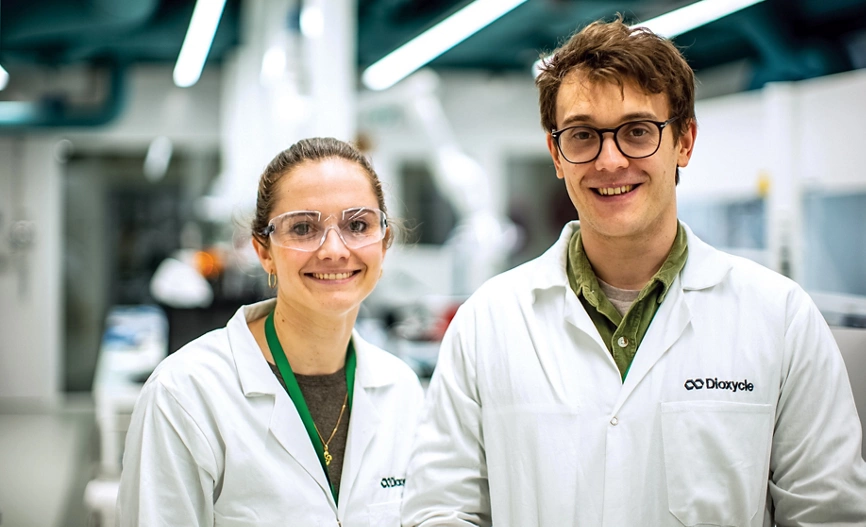
When Dioxycle was founded in 2021 by Dr Sarah Lamaison and Dr David Wakerley, both researchers with experience at the University of Cambridge and Stanford. They didn’t just see carbon dioxide as a waste to be disposed. They envisioned it as the feedstock for an entirely new way of making ethylene, one of the world’s most ubiquitous industrial chemicals.
Lamaison’s engineering background and Wakerley’s materials and catalysis expertise complement each other. Their team today is composed of dozens of PhD-level researchers and engineers working at the intersection of electrochemistry, process engineering and industrial chemistry.
That founding team strength matters not just because they understand the science, but because they understand how to take it out of the lab and into the factory. They have been thoughtful about bridging scientific proof-of-concept with real-world industrial integration.

A $200 billion chemical under siege
Ethylene is the chemical that underpins plastics, textiles, automotive parts, packaging, building materials virtually modern industrial manufacturing. The global market for ethylene is measured in the hundreds of billions of dollars annually.
Yet the conventional steam-cracking process to make ethylene is carbon-intensive, petrochemical-based and operationally dominated by incumbents. Dioxycle is targeting that massive market by offering a way to produce ethylene from waste CO₂ and renewable electricity instead of fossil fuels. That means they are addressing a problem of scale large volumes, heavy emissions and have a huge upside if they succeed.
Turning emissions into feedstock
What sets Dioxycle apart is their proprietary low-temperature electrolyzer that uses industrial carbon emissions (CO₂ or CO) + water + electricity to produce ethylene.
Their pitch: flip the script from “green premium” (paying more for a greener product) to a “green discount” (producing at equal or lower cost than the fossil alternative).
In simple terms: instead of seeing CO₂ as a liability, they treat it as a valuable raw material. And because ethylene is high-volume, high-value, every tonne of emissions turned into feedstock is meaningful. Their technology is modular, designed to embed into existing factories (steel, chemical plants) and decouple ethylene production from petroleum feedstocks.


Licensing or manufacturing at scale
Dioxycle’s model appears to have several layers. They can sell or license the electrolyzer stacks and process technology to chemical producers. They could also set up joint facilities or co-locate their system with emission-heavy facilities, earning feedstock or processing‐service revenue.
Given the size of the ethylene market (well north of $150–200 billion annually) and the pressing push for decarbonisation in heavy industry, the revenue potential is enormous. Their claim of addressing up to 800 million tonnes of CO₂ per year (1-2 percent of global emissions) underlines the scale.
Recurring revenue could stem from electrolyzer system sales plus ongoing service/support, plus possibly CO₂ feedstock contracts and offtake agreements for the ethylene produced. Because the feedstock (CO₂) is cheap and power can be renewable or subsidised, the operating cost model looks potentially attractive.
From lab to on-site demonstrator
Dioxycle moved from lab prototypes to first electrolyser stacks in 2022. Their Series A raise of US$17 million (co-led by Breakthrough Energy Ventures and Lowercarbon Capital) was announced in July 2023.
The company has been recognised by industry bodies (for example winning a “Best CO₂ Utilisation” innovation award in 2024).
While full commercial deployment has not yet been publicly disclosed at scale, the demonstrator phase is well under way. That early traction gives both credibility and investor confidence.

Modular tech for global rollout
The technology is designed to be modular and factory-embedded, meaning scalability is built into the design. Their website claims the potential to abate >800 million tonnes of CO₂ annually if widely deployed.
Because many industries already generate CO₂ emissions onsite, and many have a requirement for ethylene feedstock, the path to scale is straightforward in principle. The main constraints are capital costs, power supply (preferably renewable), and integration into existing industrial value chains factors the team appears to be addressing.
From a global business perspective, once the first few reference sites work, replication in markets across Europe, US, Asia becomes feasible and rapid.
Traditional chemicals vs carbon-tech insurgents
Dioxycle sits at an interesting intersection. On one side are legacy petrochemical players entrenched in fossil feedstocks and steam-cracking infrastructure. On the other side are emerging carbon-utilisation and electrification startups. Key competitive advantages for Dioxycle: proprietary electrolyzer tech, claimed cost-competitiveness with fossil ethylene, and modular industrial embedment.
That said, they face risks: technology risk (making electrolysis at scale with high efficiency), cost risk (electricity, capital expenditure), feedstock risk (source and purity of CO₂/CO), and incumbent resistance (chemical giants may prefer upgrade paths rather than replacement).
Their strategy appears to anticipate these by co-locating with existing emission sources, licensing rather than full asset ownership, and emphasising the green-cost story rather than a premium.

Big chemical or industrial play
For investors, several exit pathways exist. A strategic acquisition by a large chemical firm seeking to decarbonise could be likely. Alternatively, a public listing once demonstration plants scale and revenues grow is plausible. Given the size of the market and the growing pressure on chemicals to reduce carbon footprints, the acquisition story is strong.
For the founding team and early investors, the valuation upside is significant if the technology proves cost-competitive and scalable. The combination of high market size + climate relevance + industrial need makes it appealing as a major long-term industrial tech play.
Rewriting how manufacture the modern world
Dioxycle’s vision is bold: to become the “Intel Inside” of the carbon-capture-utilisation industry, enabling everyday chemicals from emissions rather than fossil extraction.
In their words: “turning emissions into feedstocks, rather than dumping them into the atmosphere.” That flips the mindset of industrial chemistry. If realised, the impact is massive: lowering industrial emissions, enabling circular feedstocks, decentralizing chemical manufacturing away from oil-geography dependency.
For a global business magazine reader, this is not just a tech story but a re-engineering of industrial supply chains.

Cost matters, not just carbon
What impresses about Dioxycle’s narrative is their emphasis on cost competitiveness, not just environmental benefit. Many green ventures rely on subsidies or premium pricing. Dioxycle explicitly markets “green discount” rather than “green premium.”
Their development path focus on modularity, embedded assets, widely available industrial emission sources shows they understand the economics. Their early funding, measured hiring of industrial-scale staff and demonstrator phase indicate discipline.
Of course, transitioning from prototype to commercial function is capital-intensive and high-risk. The team’s credibility and backing suggest they’re aware, and their early traction indicates focus.
Dioxycle is one of those rare startups where the technology, market, founding team and business model align around a large global problem. The problem is industrial emissions and fossil-feedstock addiction in the chemical industry. The market is vast. The solution is novel and technically credible. The business model is scaled, disciplined and cost-oriented. The team is strong and purpose-driven.

For global industry and for readers in business hubs the implications are clear: if Dioxycle (or a venture like it) succeeds, the way everyday materials are manufactured globally might shift from “dig fossil, crack it, emit CO₂” to “capture emissions, power electrolysis, make feedstock”. This would ripple across plastics, textiles, construction, automotive, packaging.
In short: we might look back and say this was a turning point not just in chemistry, but in how business views carbon. For the investor, entrepreneur or industrial buyer reading this magazine article, Dioxycle is one to watch.